Skip to content
Humaniwork

About

Integration is an intelligence problem before it is a political one.

Public institutions run integration policy on statistics that arrive a year late and stop at the city boundary. The data to fix that already exists. Nobody had built the layer that reads it at street level, in the languages people actually use, in time to matter.

What we do

We build the intelligence layer: neighbourhood-level early warning for municipalities, ESCO-aligned bilingual skills matching for employers, and impact evidence for incubators and funders.

We deliver it two ways. As a licensed platform, and as professional pilot engagements that end in a published, ESF+-ready report. The report is the product. A pilot that ends in a demonstration rather than a document was not a service.

What we do not do

We do not make decisions about people. The platform ranks, explains, and projects. A qualified human decides.

We do not process individual-level data in the AI layer. We do not sell the Observatory as an enforcement, policing, or targeting tool. We do not ship a module before its compliance classification is documented. We do not publish a number we cannot source.

The founders

Two halves of the migration equation, on the same page.

Twenty-nine years inside government on one side, twenty-one of them on migration governance, running the departments that licensed recruiters and protected departing workers in one of the world’s largest labour corridors. AI architecture and shipped product on the other. Institutional trust and product velocity are both non-substitutable, and a platform selling to municipalities needs both signatures.

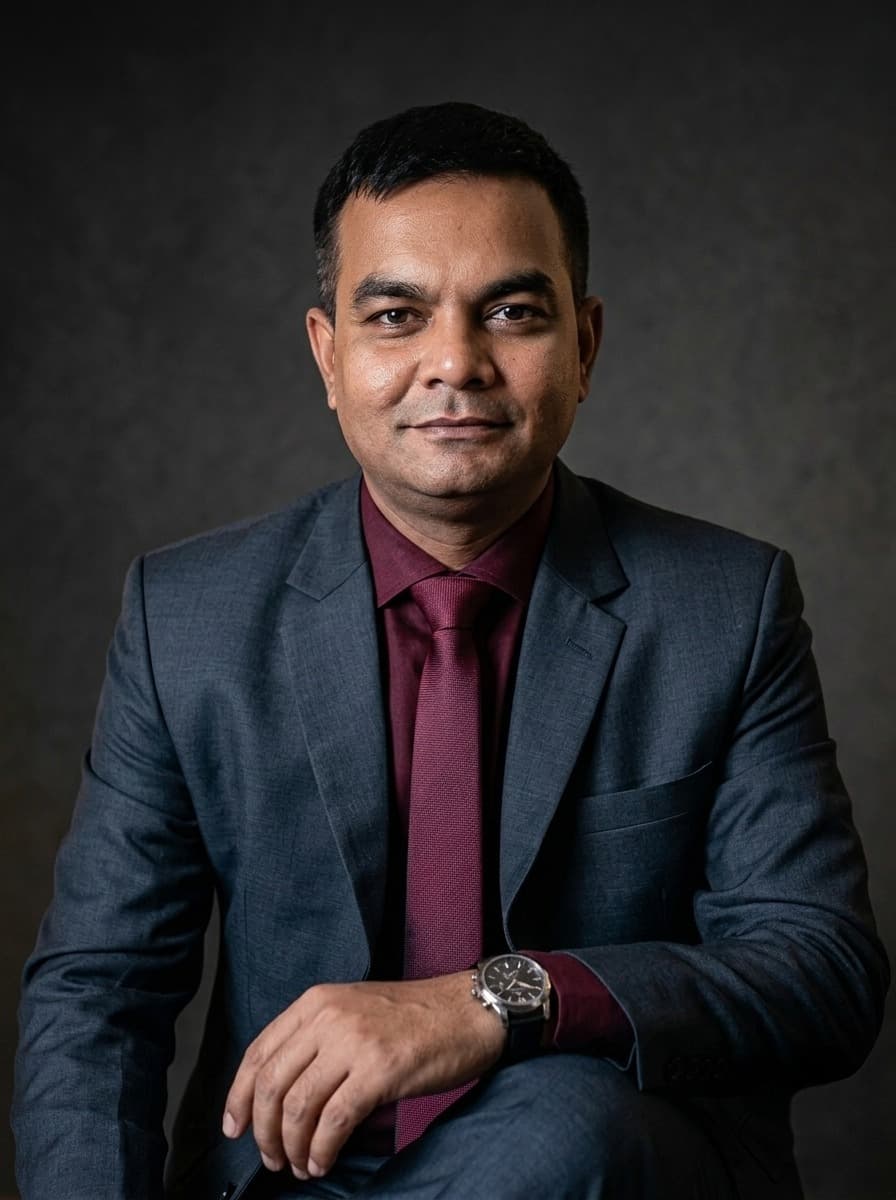
Portrait of Dr. Krishna Hari Pushkar, Founder and Managing Director of Humaniwork.

Mission, policy, and institutional strategy.

Dr. Krishna Hari Pushkar

Founder & Managing Director

Dr. Krishna Hari Pushkar is Founder and Managing Director of Humaniwork, where he leads mission, policy, and institutional strategy: the design of the Observatory methodology, the public sector partnership model, and the institutional relationships that put integration intelligence into the hands of the people making decisions.

He built Humaniwork after twenty-nine years inside government. He joined Nepal’s civil service in 1997 and was promoted to Secretary to the Government of Nepal in 2021. His migration and labour work runs the length of that career. He was Director General of both the Department of Foreign Employment and the Department of Labour, the agencies that process and protect the hundreds of thousands of Nepali workers who leave the country each year, and later Secretary of the Ministry of Labour, Employment and Social Security, where he led the National Labour Migration Policy 2082 and the framework extending collateral free lending to departing migrant workers.

His remit was never only migration. He served as Finance Secretary and Revenue Secretary at the Ministry of Finance, as Secretary at the Office of the Prime Minister and Council of Ministers, and as Secretary at the Ministry of Federal Affairs and General Administration during Nepal’s federal transition. He sat on the Board of Directors of Nepal Rastra Bank, the central bank, served as an Executive Member of the National Planning Commission, and chaired the Employees Provident Fund and the Deposit and Credit Guarantee Fund. Internationally he was Alternate Governor for Nepal at the World Bank Group and the Asian Development Bank, and Alternate Council Member at the Global Environment Facility for the constituency covering Bangladesh, Bhutan, India, the Maldives, Nepal, and Sri Lanka.

He is a Fulbright Hubert H. Humphrey Fellow of Michigan State University. He works in English and Nepali and lives in Barcelona.


Portrait of Desh Deepak, Co-Founder and Chief Technology and Strategy Officer of Humaniwork.

Technical build and product strategy.

Desh Deepak

Co-Founder & Chief Technology and Strategy Officer

Desh Deepak is Co-Founder and Chief Technology and Strategy Officer at Humaniwork, where he leads the design and build of the platform’s AI systems and its product strategy: multilingual workforce matching, integration intelligence, and privacy-first architecture aligned with GDPR and the EU AI Act.

He is also the founder of Gott Data, an AI solutions and decision intelligence advisory based in Reykjavik, serving European mid-sized companies and public institutions across e-commerce, manufacturing, travel, and government. At Gott Data he has shipped five named AI products, including Munin, a generative AI chatbot portal, and delivered production systems for clients including BUFF, TourDesk, and government bodies. He has been involved in several AI ventures as co-founder, technical partner, and advisor, taking products from first architecture to live deployment.

His connection to Humaniwork’s mission is personal. Born in Nepal, educated in the US, and building a career across Iceland and Spain, he has lived the integration journey the platform is built to support. Before turning to technology he worked as a diversity and belonging officer at Hendrix College, where he learned the conviction that still drives his work: technology only works when people trust it. Through Statloba For Good, the 501(c)(3) he co-founded, he delivers pro-bono AI, data, and leadership training to organisations in Zambia, Nepal, Kenya, and Niger.

He works in English and Spanish and lives in Barcelona.

Academic review

We send the method out for review before we run it on anyone.

A per-delivery academic sign-off would not survive a university calendar, so we do not promise one. The method is reviewed before it runs, re-reviewed on a cycle, and what an engagement teaches goes back to the group that reviewed it.

  1. Reviewed before it runs

    The method goes out for review before it touches anyone’s data.

    Index design, baseline construction, and simulation parameters are written as documents and reviewed by a research group that works on that subject. The method is separable from the software on purpose, so it can be evaluated by people who did not build either. An output produced by a method that has not been through this says so on its face.
  2. Re-reviewed on a cycle

    Annually, and whenever the method changes materially.

    Not per client and not per delivery. An engagement runs a version of a method that was already reviewed, and anything an engagement adds goes into the next cycle rather than holding up the work. The version that produced a given output is recorded on it.
  3. What we learn goes back

    Findings, method changes, and failures return to the research group.

    A review is worth something to a research group only if the deployment feeds it. Anonymised findings and the record of what did not work go back, for further research and for the policy questions that research exists to answer. This is the half of the arrangement that makes it a collaboration rather than a favour.

Where we work

A European product, proving itself in a demanding place.

We are based in Barcelona and our first pilots run in Catalonia, where a quarter of residents were born outside the country and municipalities carry the delivery. If the method works here it works.

The next markets are France, Italy, and Portugal, chosen because they share what matters: municipal responsibility for integration, sub-municipal statistical geography, and the same regulatory frame. GDPR and the EU AI Act apply identically in all of them, which is why the compliance architecture is the product rather than a local adaptation of it.

Values

Eight words, and the decision each one makes.

  • Intelligence
  • Patience
  • Candour
  • Rigour
  • Integrity
  • Conviction
  • Clarity
  • Dignity

Each one settles an argument before it happens. What it settles is a click away.

No observatory is configured, no match generated, and no simulation produced without validated data infrastructure behind it: a documented, GDPR-compliant pipeline, a signed DPA, and a briefed municipal Data Protection Officer. Every time, without exception.
No pilot begins before the Diagnostic Sprint is complete: stakeholder map, KPI framework, data gap analysis, DPA executed. We will tell a municipality to wait. Two weeks of delay is worth six months of invalid baseline data.
If an indicator is producing noise, we say so. If a match falls below threshold, we say so. If the pilot is not generating the documentation your funder needs, we say so first and propose the fix.
Cohesion index design, baseline construction, simulation parameters: the method is written as a document and reviewed by the relevant institution before it runs on anyone’s data, then re-reviewed on a cycle rather than re-argued at every delivery. What an engagement teaches goes back to the group that reviewed it, and every output carries the review state of the method that produced it.
No ingestion without a signed DPA. No module deployed without its EU AI Act classification documented and the Data Protection Officer briefed. Not a checkbox. The doorway.
We will not sell a module for a use it was not built for. The Observatory is an early-warning system for public service allocation. It is not an enforcement tool, a policing input, or a targeting instrument, and any contract that asks it to become one is declined.
A councillor, a Data Protection Officer, and an HR manager must all be able to read our output without a translator. Technical depth belongs in the appendix. The finding belongs in the first sentence.
Anonymisation at ingestion, aggregation before analysis, no individual-level data in the AI layer. We report on neighbourhoods and cohorts, never on identifiable people. This is an architectural constraint, not a policy preference.

And the standards that follow from them

  • We do not build tools that watch individuals
  • We do not sell data that works against the people the platform serves
  • We do not start without a signed data agreement
  • We do not ship methodology that has not been validated

Start with a diagnostic.

Your note goes to one of the two founders by name. You will have a reply within two working days.