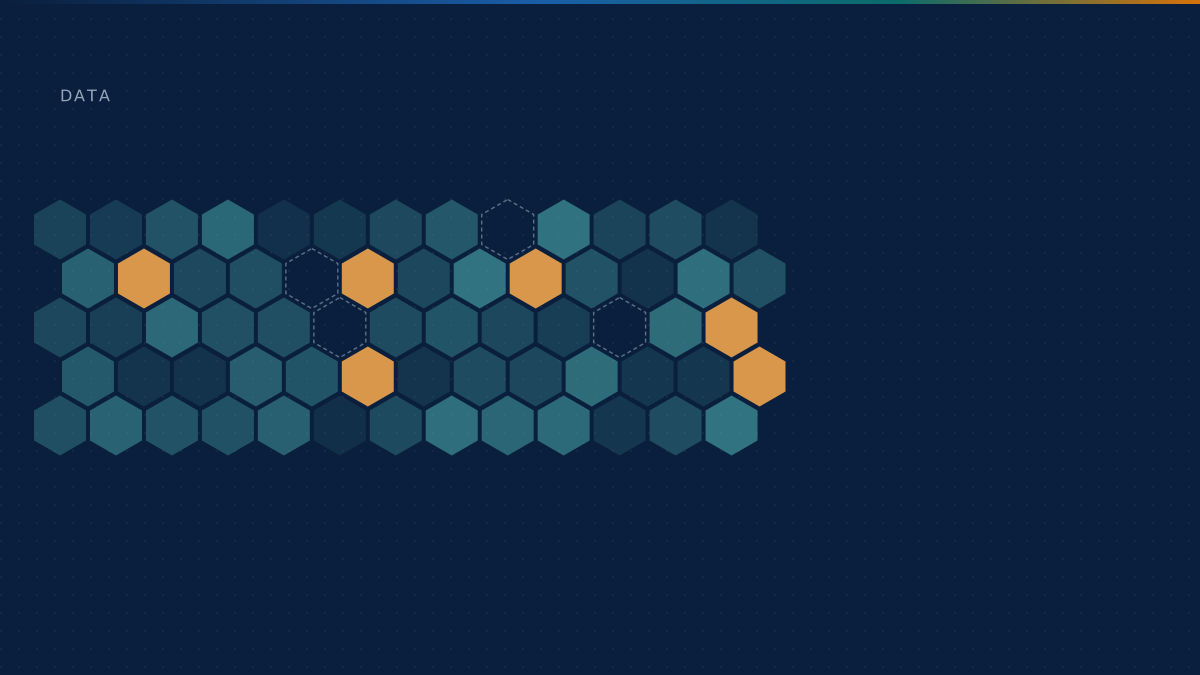
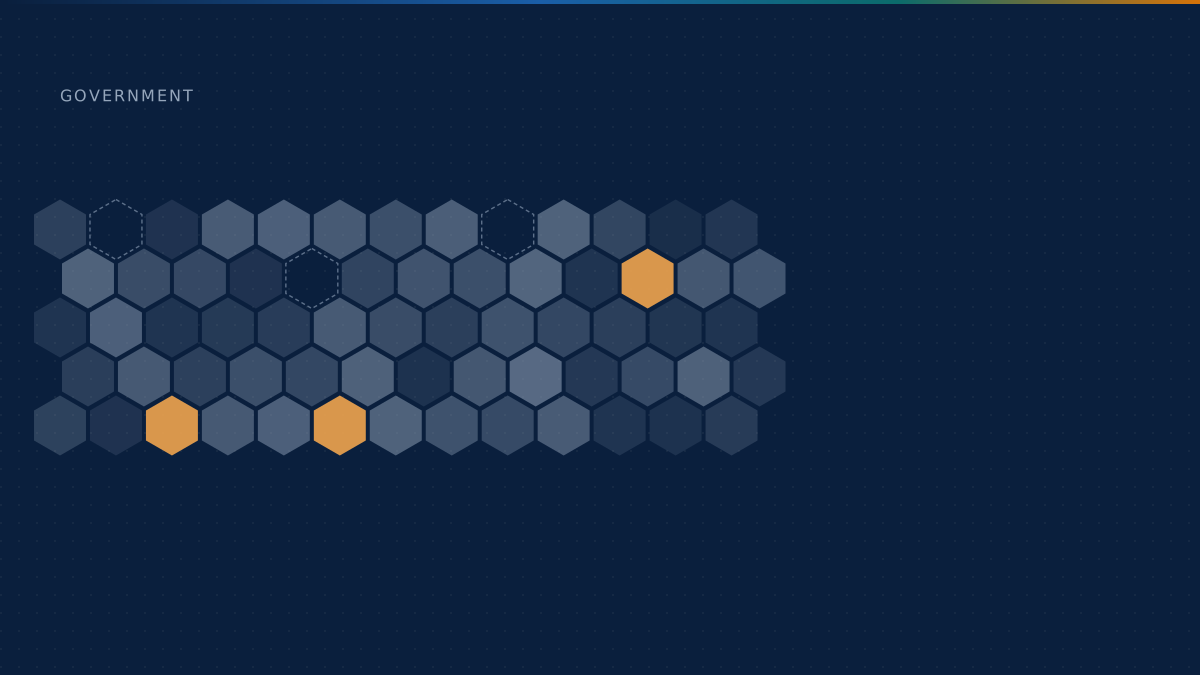
Where first contact with a municipal service is rising.
Amber marks a neighbourhood past the level worth acting on·Boundaries: Ajuntament de Barcelona open data
What Humaniwork does
Six weeks, not six months
A signal you can still act on.
National statistics arrive a year late and stop at the city boundary. The Observatory reports at neighbourhood level on a weekly cadence, so a service can be moved while the movement is still happening rather than described in next year’s annual report.
The whole picture
Workforce data and civic data on one spine.
Workforce platforms see the labour market and not the neighbourhood. Civic dashboards see the neighbourhood and not the labour market. Integration happens where the two meet, so that is where we built.
Compliant by architecture
Anonymised before the analysis, not after.
Personal identifiers are stripped at the ingestion boundary, so no individual-level record reaches the AI layer. EU data residency, per-module AI Act classification, and a signed DPA before a single record moves.
Why now
The demographic change already happened. The instrumentation did not.
New permanent immigrants
368,000
Admitted to Spain in 2024, fifth in the OECD.
SOURCE: OECD INTERNATIONAL MIGRATION OUTLOOK · 2024
Of new jobs
79%
Share of new Spanish jobs filled by migrant workers in 2024.
SOURCE: OECD INTERNATIONAL MIGRATION OUTLOOK · 2024
Born outside Spain
25.1%
More than one in four Catalonia residents, 2.04 million people.
SOURCE: IDESCAT · 2025
Integration policy runs on statistics that arrive a year late and stop at the city boundary. A municipal director gets a national figure in an annual report. What they need is a neighbourhood signal on a Monday morning.
Municipalities run the Observatory and the Policy Simulator. Employers run Workforce Matching and Employer Intelligence. Integration Intelligence turns both into the evidence your funder asks for.
Two modules are at delivery quality. Three are architected and stubbed.
We would rather ship two modules that survive a Data Protection Officer’s review and produce a publishable report than five at demonstration quality. Each module below says which it is.
Every engagement opens with a two-week Diagnostic Sprint.
You will know exactly what the platform can and cannot tell you before you commit to a pilot. If the data is not there, we say so in week two and tell you what would change that.
01
Stakeholder map
Week 1, days 1 to 3
We find out who decides, who is accountable, and who has to be convinced.
A one-page stakeholder map with the decision path and the objections named.
02
KPI framework
Week 1, days 3 to 5
We agree what the engagement is for, in numbers, before anything is built.
A signed indicator specification, and the version of the reviewed method it is built on.
03
Data gap analysis
Week 2, days 1 to 3
We tell you what the platform can and cannot see with the data you actually hold.
A data gap report naming every indicator that cannot be produced, and what it would take to produce it.
04
DPA executed
Week 2, days 3 to 5
The Data Processing Agreement is signed and your DPO is briefed before a record moves.
An executed DPA, a briefed DPO, and a recorded classification for every module in scope.
05
The decision
End of week 2
You decide whether to run a pilot, knowing exactly what it will and will not tell you.
A decision, and a document you can put in front of a council, a funder, or an auditor either way.
We send the method out for review before we run it on anyone.
Once before it runs, again on a cycle, and what it teaches goes back to the people who reviewed it. The method is written as a document so it can be evaluated separately from the software.
Reviewed before it runs
The method goes out for review before it touches anyone’s data.
Index design, baseline construction, and simulation parameters are written as documents and reviewed by a research group that works on that subject. The method is separable from the software on purpose, so it can be evaluated by people who did not build either. An output produced by a method that has not been through this says so on its face.
Re-reviewed on a cycle
Annually, and whenever the method changes materially.
Not per client and not per delivery. An engagement runs a version of a method that was already reviewed, and anything an engagement adds goes into the next cycle rather than holding up the work. The version that produced a given output is recorded on it.
What we learn goes back
Findings, method changes, and failures return to the research group.
A review is worth something to a research group only if the deployment feeds it. Anonymised findings and the record of what did not work go back, for further research and for the policy questions that research exists to answer. This is the half of the arrangement that makes it a collaboration rather than a favour.
Built for the DPO
Compliance is the doorway, not the disclaimer.
Six promises. Your Data Protection Officer gets the documentation behind each one before the pilot starts, not after.
Anonymisation at ingestion
No individual-level data reaches the AI layer.
No individual-level data enters the AI processing layer. Analysis runs on aggregated and pseudonymised data, and the rule is enforced at the pipeline boundary rather than by convention.
EU data residency
EU infrastructure, Catalan residency for Catalan deployments.
Infrastructure in EU jurisdiction, with Catalan data residency for Catalan deployments. The sub-processor list is published and versioned.
Per-module EU AI Act classification
Classified per module, before deployment, because they differ.
The classification is documented per module before deployment, because the modules are not equivalent. Employment-related matching is treated under the high-risk obligations. The civic analysis modules are advisory decision-support for institutions.
A human decides
The platform ranks and explains. A person decides.
The platform ranks, explains, and projects. A qualified human makes every hiring and every policy decision, and the decision is logged against their identity.
DPA before ingestion
Signed, and your DPO briefed, before a record moves.
A signed Data Processing Agreement and a briefed Data Protection Officer before a single record moves. The system refuses to create a data source without a recorded DPA reference.
Exportable audit trail
Every output keeps what produced it, and exports.
Every match, alert, and projection persists its inputs, model version, driving features, and confidence value. Exportable for labour inspection and public audit.
The interval between a neighbourhood signal appearing in administrative data and the point where a response still changes the outcome is about six weeks. Most municipalities are working eighteen months behind it.
More than a quarter of Catalonia’s residents were born outside Spain. The figure is accurate, widely quoted, and almost useless for planning a service, because the thing it averages away is the thing you need.
Six questions decide whether a municipal AI pilot happens. They are asked in the same order every time, and a vendor who cannot answer the first two rarely gets to the third.
Desh Deepak
Start with a diagnostic.
Your note goes to one of the two founders by name, and you will have a reply within two working days. No questionnaire, no calendar to book.